
While the new income tax law replaces the Income Tax Act, 1961 and omits 13 offences, 35 actions and omissions continue to attract criminal liability under 13 provisions.

'First-time investors, busy professionals, NRIs and those with modest sums looking for curated strategies may find FoFs especially appealing.'

The government on Tuesday proposed a relief to taxpayers with respect to capital gain tax on real estate properties by giving them the option to choose between 20 per cent and 12.5 per cent tax rates.

The Union Finance Ministry on Friday announced key amendments to foreign exchange (forex) regulations, including mandating government approvals for all investments originating from countries that share land borders with India. The latest amendments also seek to simplify cross-border share swaps and streamline key definitions, such as "control". The updated regulations have aligned the treatment of downstream investments made by overseas citizen of India (OCI)-owned entities with those owned by non-resident Indians (NRIs) on a non-repatriation basis.

New Delhi and Washington have agreed to count the benefits of a global agreement on taxation from the next financial year. However, the benefits would actually accrue once the global pact comes into effect or March 31, 2024, whichever is earlier, in the form of credit.

Currently, if the IT department finds out that some income has been missed out by the assessee, it goes through a lengthy process of adjudication, and the new proposal would repose trust in the taxpayer.

Besides wrong selection of ITR form, many professionals claim deductions they are ineligible for.

Errors in filing income-tax returns frequently lead to scrutiny notices, additional liabilities, or delayed refunds.

'The new Bill introduces no policy or rate changes, leaving financial planning strategies largely unaffected.'
'The considerations for choosing between the old and new tax regimes remain essentially unchanged.'

'The increase in the limit for TDS on interest to Rs 1 lakh will ensure greater cash flow in the hands of senior citizens.'

Finance Minister Nirmala Sitharaman will set a record by presenting the sixth Budget in a row -- 5 annual Budgets and one interim -- a feat achieved so far only by former Prime Minister Morarji Desai. With the presentation of interim Budget on February 1, Sitharaman will surpass the records of her predecessors like Manmohan Singh, Arun Jaitley, P Chidambaram, and Yashwant Sinha, who had presented five budgets in a row. Desai, as Finance Minister, had presented five annual Budgets and one interim Budget between 1959-1964. The interim Budget 2024-25 to be presented by Sitharaman on February 1, will be a vote-on-account that will give the government authority to spend certain sums of money till a new government comes to office after the April-May general elections.

The government has notified mandatory requirement of e-invoicing for B2B transactions for businesses with a turnover over Rs 100 crore with effect from January 1, 2021. Under Goods and Services Tax (GST) law, e-invoicing for business-to-business (B2B) transactions is mandatory for companies with turnover of over Rs 500 crore from October 1. In a notification, the Central Board of Indirect Taxes and Customs (CBIC) said e-invoicing will be extended to businesses with a turnover over Rs 100 crore from January 1.

A day ahead of the interim Budget, India slashed import duty on spare parts, like battery cover, lens and SIM socket, used in mobile phone manufacturing to 10 per cent, from 15 per cent. The duty cut is aimed at boosting local production and exports, as well as reducing prices in local markets. The finance ministry on January 30, notified the cut in duty on all goods for use in manufacture of cellular mobile phones to 10 per cent.

The apex court has settled the long-pending dispute between companies such as Samsung, IBM, HP & others and the tax department.

Union Finance Minister Nirmala Sitharaman on Tuesday announced that income from digital asset transfers will be taxed at a rate of 30 per cent. This move is seen as 'crypto tax'.

The income tax department has allowed non-resident taxpayers not having PAN to file Form 10F manually till March 31, 2023, a move which would ease their compliance burden and enable them to claim lower TDS rate. The Central Board of Direct Taxes (CBDT) had in July made it mandatory for non-resident taxpayers to file Form 10F electronically to claim benefit of lower Tax Deducted at Source (TDS). However, taxpayers faced problems in electronic filing of the form as the income tax portal did not allow a taxpayer who does not have a Permanent Account Number (PAN) to file Form 10F.

Tax consultants and chartered accountants have started receiving a flurry of calls from their clients - both corporate and individuals - seeking clarity over changes in the reassessment regime made during the recently concluded Budget Session of Parliament. Tax experts apprehend the amendments may lead to the income-tax (I-T) department sending out more notices. The new provisions, effective from April 1, have extended the scope for tax sleuths to reopen the past assessments.

Sources said about hundreds of companies, including Facebook and Amazon, could seek tax refund because they import software for sale in India.

The Central Board of Direct Taxes (CBDT) has proposed a new common income-tax return (ITR), with greater focus on disclosing income from virtual digital assets or crypto assets and foreign equity and debt instruments held by resident Indians. For non-resident Indians, the draft ITR seeks exhaustive details ranging from nature of business, permanent establishment (PE), business connection, whether the entity has significant economic presence (SEP) in India, along with the number of users in India. The ITR protocol for NRIs could widen the scope of the SEP principle that was introduced in the Finance Bill 2018-19, and the explicitly defined 'business connection' to include provision of download of data or software, if aggregate payments from such transactions exceed a prescribed amount, or if a multinational's interaction is with a prescribed number of users.

Six years after the rollout of the biggest indirect tax reform in India, Goods and Services Tax (GST) revenue of Rs 1.5 lakh crore every month has become a new normal and tax officers are focusing on dealing with fraudsters who are adopting newer modus operandi to game the system, causing loss to the exchequer. To apprehend black sheep, who operate as syndicates and create fake entities on the basis of forged documents to claim input tax credit (ITC), tax officers have started using data analytics, artifical intelligence and machine learning aiming to curb evasion, which was over Rs 3 lakh crore since inception of GST. It was over Rs 1 lakh crore in 2022-23. Thinktank Global Trade Research Initiative (GTRI) said the most critical pending GST reform is upgradation of GST Network to prevent fake supplies and fraudulent claims of Input Tax Credit (ITC).

Alternative Investment Fund refers to any fund established or incorporated in India which is a privately pooled investment vehicle that collects funds from sophisticated investors, whether Indian or foreign.

The new amendment, which came into force on April 21, has been introduced to detect discrepancies between the expenses and incomes of people who do not have to file tax returns.

This could impact non-resident Indians staying in countries such as UAE which does not impose income tax on individuals under local tax laws.

Companies wanting to consider treaty benefits and deducting tax at a lower rate will have to examine the qualitative factors. They will have to consider whether FPIs are liable to tax and whether they are the beneficial owner of dividend income.

The government on Friday announced that no tax will be charged on overseas spending of up to Rs 7 lakh in a year using debit or credit as it looked to douse backlash from its earlier decision of levying TCS on all spending. The government had earlier this week brought overseas credit card spending under Liberalised Remittance Scheme (LRS). This meant that any spending using credit cards overseas would attract a 20 per cent tax from July 1.

India's exports may have touched an all-time high of $422 billion in 2021-22 but recession in key western markets and geo-political crisis due to the Russia-Ukraine war are expected to impact the growth of the country's outbound shipments in 2023. All the global trade promoting factors like political stability, movement of goods, adequate availability of containers and shipping lines, demand, stable currency and smooth banking systems are in disarray. Adding to the woes, COVID cases have again started rising in countries like China, Japan, South Korea and the US.

The government on Friday proposed hiking the securities transaction tax on Futures & Options (F&O) contracts, a move that will increase the trading costs in the derivatives segment as well as help in curbing excessive trades. In the Finance Bill 2023, passed by the Lok Sabha on Friday, the Securities Transaction Tax (STT) on options is proposed to be increased to 0.0625 per cent from 0.05 per cent and on futures contracts to 0.0125 from 0.01 per cent. Analysts opined that higher STT will shore up the government's revenues to some extent and also discourage excessive trading since a large number of retail traders are losing money in the segment.

Last year's Budget had created uncertainty about the quantum of tax to be withheld on dividends paid to non-residents, as the exact tax rate was not specified under section 195.

India conceding ground to bring only top 100 digital companies like Google, Facebook, and Netflix into the global taxation pact may have revenue implications. This will mean that New Delhi will have to withdraw the contentious 2 per cent equalisation levy on e-commerce operators by 2023. This may have revenue implications for India, experts pointed out, as the equalisation levy has a much lower annual revenue threshold of Rs 2 crore (euro 0.2 million) as against euro 20 billion agreed by 130 countries at the Organization for Economic Cooperation and Development (OECD). India, along with other developing countries, was pitching for at least euro 1 billion threshold to cover at least 5,000 global entities. India collected Rs 2,057 crore from the equalisation levy in 2020-21, an 85 per cent growth over Rs 1,136 crore in the previous fiscal.

As per the Budget proposals, migration of a fund to a fund in IFSC will not be regarded as transfer if done on or before March 31, 2023. Transfer of units will be tax neutral. Grandfathered investments of the fund to continue to enjoy capital gains exemption on future sale by the IFSC fund. There is no impact on carry forward of losses for the investee company.

In a move to plug gaps in the Insolvency and Bankruptcy Code (IBC), the ministry of corporate affairs (MCA) has proposed robust norms against avoidance transactions, wrongful trading, and inordinate delays via changes to look-back period and fixed timelines for the tribunals to reject or approve plans, among other measures. The MCA has proposed that the IBC should provide the adjudicating authority with 30 days for approving or rejecting a resolution plan under Section 31. If a decision is not made on the resolution plan within that period, the adjudicating authority will record reasons in writing for the same, the ministry has proposed.

The US Trade Representative's (USTR) office will also conduct the Section 301 probe against nine others, including Austria, Brazil, Indonesia, Italy, Spain, Turkey, the Czech Republic, the UK, and the EU, for levying or considering digital services taxes "discriminating against US companies".

The CMS allows e-adjudication of certain lapses and paying penalties online, doing away with the need to visit an MCA office or go through a legal process.

There is considerable speculation as to whether this award would have any bearing on another Vodafone-type case, namely, the ongoing tax-related arbitration proceedings with Cairn Energy.

E-commerce giants such as Amazon, Netflix and Flipkart, whose headquarters are not in India, potentially have to pay the additional levy of 2 per cent from April 1.

'Rationalising TDS on dividends for FPIs to reduce it to treaty rates ranging from 5 to 15 per cent, depending on the country of residence of FPIs from current rate of 20 per cent will provide a big cash flow relief for FPIs.'

The government on Saturday made its prior approval mandatory for foreign investments from countries that share land border with India to curb 'opportunistic takeovers' of domestic firms following the COVID-19 pandemic, a move which will restrict Foreign Direct Investment from China.

A series of steps taken by the government to promote ease of doing business and liberalisation of foreign direct investment norms have helped India receive record FDI inflows so far this year, and implementation of measures like PM Gati Shakti, single window clearance and GIS-mapped land bank are expected to further push investments in 2022. Notwithstanding the global slowdown and the COVID-19 pandemic, total foreign direct investments into India rose to a record $81.72 billion in 2020-21. During April-July this fiscal, FDI (foreign direct investment) into the country increased by 62 per cent to $27.37 billion.

US proposal to raise the global corporate tax rate to 28% from 21% might face resistance from countries unwilling to give up their edge and compete with America on its terms.
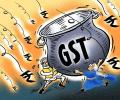
With Goods and Services Tax (GST) officers under pressure to exceed the Rs 1-trillion collection mark per month, industry has faced a barrage of recovery notices and summons issued over the last one month across sectors, according to company executives. Industry bodies have claimed harassment by field officers, blocking of input tax credit, cancellation of GST registration, threats of arrest and steep penalties, impacting their working capital and operations. Company executives pointed at an atmosphere of apprehension and fear due to such notices and summons.
 © 2026 Rediff.com - Advertise with us - Disclaimer - Privacy Policy - Sitemap - Feedback - About us - Terms of use - Grievances